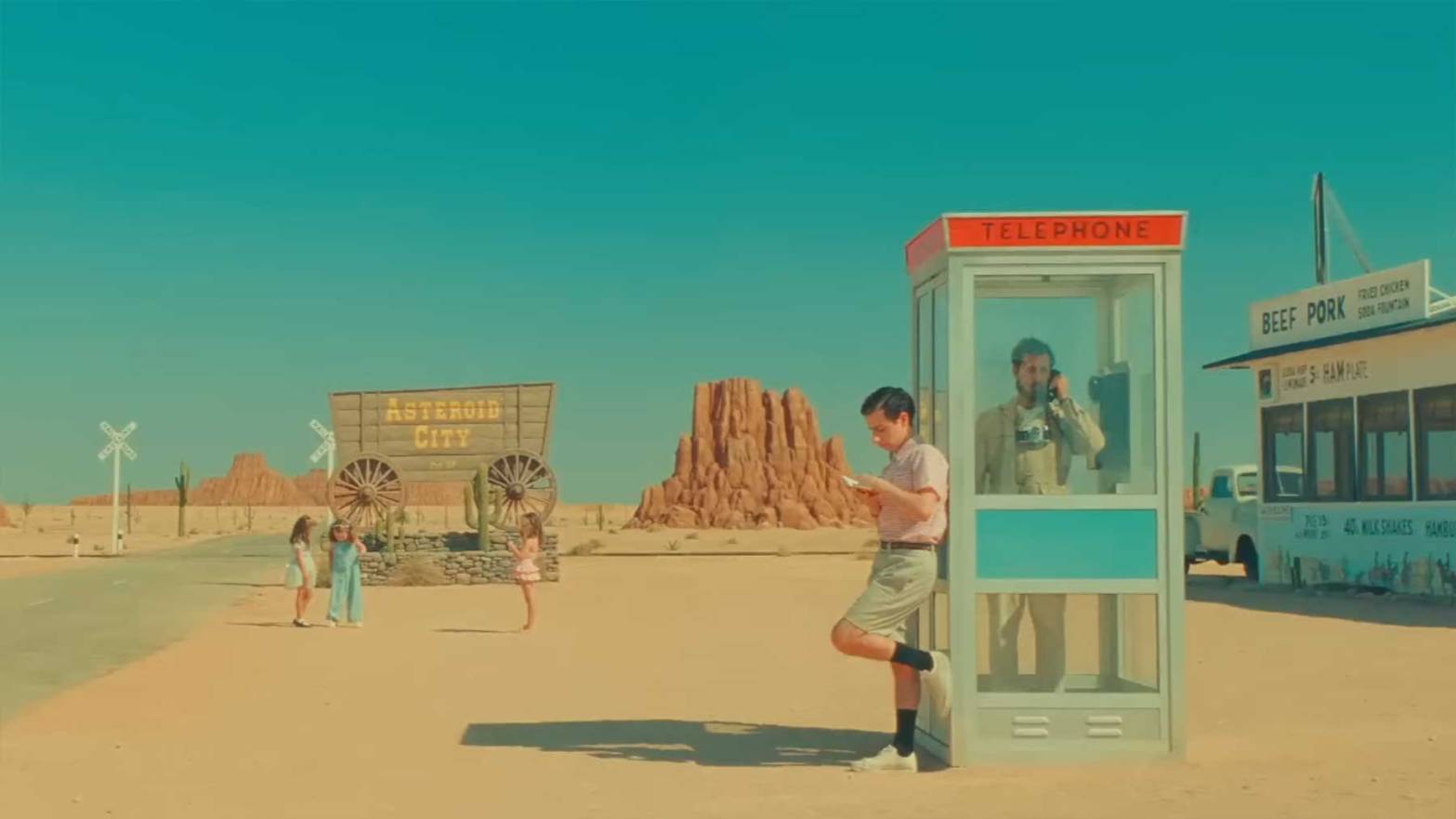
Off of the back of The Grand Budapest Hotel in 2014, Wes Anderson made a very deliberate choice to veer away from the expected. While Anderson has been a notable auteur in the industry arguably since his debut film, Grand Budapest seemed to be on a level only rivaled by The Royal Tenenbaums when it came to both critical reception, audience turnout, and box-office figures. But Anderson has never been one to follow the script, he followed up Grand Budapest with Isle of Dogs and The French Dispatch two films I am very fond of but that didn’t reach the same level of success or hype that Grand Budapest did. At this point many directors would of course correct, they would opt for a script that would cater to the masses to re-establish their position. But Anderson didn’t.
Instead, Anderson, alongside frequent collaborator Roman Coppola, spent their time during the COVID-19 pandemic creating Asteroid City. A film that bridges the gap between Anderson’s 2010s films which have a much heavier focus on style and aesthetic with the hard-hitting and emotional side of his work that can be seen in his run of films from the 2000s. This isn’t to say that his films in the last decade aren’t emotionally driven nor am I saying that his work in the aughts is lacking in style or flair; but Asteroid City seems to take the best parts of both decades and combine them to create a genuinely beautiful film both thematically and visually.
The trailer presents the film as trailers present most of Anderson’s films; a quirky, brightly colored and symmetrically centered film about an odd-ball collection of characters most of whom are smoking cigarettes and talking with funny cadence. But as the film opens, Anderson & Coppola flip the script, because Asteroid City is a dizzying labyrinth of a film in which the audience is watching a television program, about the making of a play, which is the “film” as we understand it. The show and play are separated by the use of color with the TV show being in Black and White while the “performance” of the play is shown in full color. There is a further distinction by the use of varying aspect ratios, but ultimately both of these distinctions are toyed with as the film progresses.
The ‘play’ is the magnum opus of Edward Norton’s Conrad Earp, and focuses on the interplay between Death and Space, and the uncertainty both of these create in humans. While Jason Schwartzman’s Augie, grapples between his own confused emotions about becoming a widower, with the existential threat of alien life which is proved during a Lunar ellipses all the visitors to the titular city experience. While this concept is strong enough to work on it’s own, the metatextual layer of these characters actually being actors playing these characters allows Anderson to explore the connection between these themes and humans connection to art itself.
The moment everything clicks into place for me, is a scene where Jason Schwartzman’s Jones Hall (the actor playing Augie in the play), breaks character and leaves the set to discuss his own confusion at his character’s motivation with the director (played by Adrian Brody). The exploration of the actor reflects the exploration of a human, questioning the very nature of life itself. As the character is trying to understand why his character within a character acts the way he does, he is also questioning why anyone does anything. This scene is then followed up with my favorite scene in the film (and easily top 5 favourite scenes in any Wes Anderson film) when Schwartzman goes onto the theatre balcony and encounter’s Margot Robbie’s “wife/actress” character. Robbie is playing the actress who played Schwartsman’s wife in a scene that got cut (aside from a photograph of her still being used).
The scene becomes almost metaphysical because it is both the actor meeting and reminiscing about the cut scene but also the character engaging in an quasi-dream sequence where he meets his deceased wife, who provides the support both he and the actor needs to understand their character and themselves. I think it’s a truly genius scene that is enhanced superbly by Robbie’s incredible monologue. For me, this scene demonstrates the crux of the film’s message, which is that, for humans to understand the mysteries of life, whether it be death, the fear or excitement of extraterrestrial life, and even the meaning that our existence has, the only way to do this is through the arts. This juxtaposes the scientific side of the film (it is after all based around the events of a science fair), and while Anderson doesn’t dismiss the achievements that science can bring, it is clear that the film believes that the answers to life’s biggest questions can’t be solved by science alone, but requires humans to engage with the humanities to find their own solace in the world.
Written during a global pandemic, with an obvious nod to this inspiration through the quarantine the characters go through, it is easy to see why Anderson & Coppola decided to focus the themes around existentialism. At the time of writing in the film there were so many unanswerable questions about the meaning of it all, with death tolls rising each day and millions of people in lockdown trying to figure out how to spend their time. But this is what I love about Asteroid City, because its conclusion isn’t telling you what Anderson or Coppola’s thoughts are on the meaning of life, instead it’s them telling you where to find your own answer.
What I felt was missing from the “day in my life but I’m in a Wes Anderson film” TikTok craze was the fact that people see Wes’s style as just the picturesque framing, vibrant color palette and vintage nostalgia. When in reality, throughout all of his films, Wes has employed this visual style to clash with the emotional turmoil of his characters and their experience. Asteroid City is no different in this sense, even adding to the manufactured nature of the style by it literally being manufactured for the titular play, but beneath all of the visual tricks and style there remains a palpable sense of confusion, isolation and grief that meshes perfectly with the pristine visuals.
Asteroid City confirms what I’ve been feeling for a while, that Wes Anderson is on a hot streak with no signs of ending anytime soon. For a director that smashed into pop culture in the early 00s, there was definitely a time when the general sentiment was that Anderson had peaked with films like The Royal Tenenbaums & The Aquatic Life of Steve Zissou, but between The French Dispatch & Asteroid City, the proof is clear that Wes is cruising steadily in his own lane with no signs of slowing down.
 A Fistful of Film
One thought on “Asteroid City (2023) – Watch the Stage-Bound Skies”