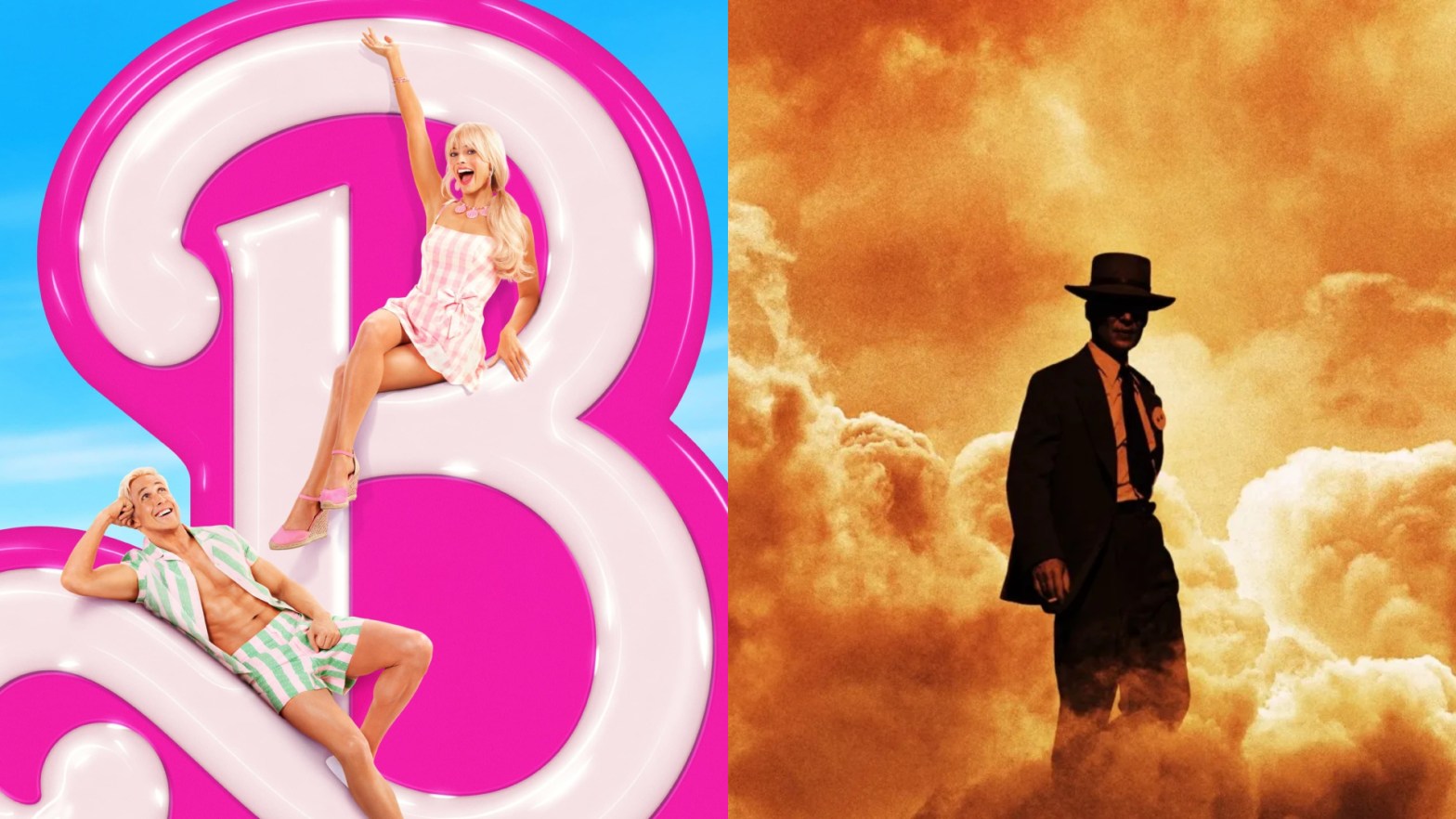
It’s not often that a brand-based fantasy comedy and an epic historical biopic wind up sharing top slots in the public marquee, but ever since their same-day releases were announced, the perplexing novelty of Greta Gerwig’s Barbie and Christopher Nolan’s Oppenheimer as an unintentional double bill has taken the World Wide Web by storm and yielded top-notch results at the box office. But as the glittery mushroom cloud begins to dissipate, the obvious question has remained: are they any good?
Our critics Amos Lamb and David Alkhed are here to tell you what they made of this summer season’s strangest blockbusting duo.

Barbie (2023) by Amos Lamb
There has been a lot of talk, hype and clamor about Greta Gerwig’s newest film Barbie. But before we talk about the film itself, we need to address the 7.26 Billion Dollar elephant in the room…Mattel.
At its core, Barbie is a corporate advertisement, trying to boost sales of their flagship toy: Barbie. This fact can’t be ignored when discussing the film, especially considering what Gerwig does with the film. It muddies the water and complicates feelings towards it because, despite the jabs aimed at Mattel, it always feels weirdly complicate in the overarching corporate goals of profit. A great example of this is when Margot Robbie’s Barbie is taken to Mattel’s head-quarters and when meeting the all-male executive boardroom asks to meet the female CEO. It’s a funny moment that takes a light-hearted swipe at how corporations present themselves as feminist while excluding women, specifically women of color, from executive and high-level roles. But this joke becomes less funny and more questionable when you look up the actual executive team of Mattel and see that it is not only overwhelmingly male, but also exclusively white.
It’s in this way that Barbie exists in a weird in-between space where Gerwig makes a very emotional and moving feminist film about perhaps the most famous icon of “womanhood” in modern culture, but it’s shadowed by a corporation that is now selling £70 movie tie-in dolls. While I have no doubt the suits signing off on the film do agree, to some degree, in it’s themes and message, with Mattel actually implementing real-world changes it all ends up feeling performative and shallow. It’s fine to recognize these issues as problems, but without action it all feels hollow. Obviously, this isn’t Gerwig’s fault or problem, and it would be unfair to tarnish what she does with the film with the real world inaction of the company, but for Mattel to sign off on this without any form of reflection, it feels like another example of a company offering lip-service to cater to a progressive demographic.
But lets set this aside and talk about the main attraction. Greta Gerwig has managed to achieve something that I genuinely do not believe will happen again. Knowing that this film can be boiled down to a two-hour advertisement, Gerwig still manages to circumvent the usual trappings and has actually made a film that is emotional, moving and genuinely empowering. In the wake of the success of Barbie, we’re going to see an era of films that will try and copy and emulate the success of Gerwig’s film and I honestly don’t think we’ll ever see a corporate film that has the same humanity as Barbie does. Gerwig has found a niche, in taking a film that was in production limbo for decades and leveraged her own star-power to get the freedom to make a film that both celebrates the womanhood and femininity that Barbie-dolls have offered to women & children for generations, while also reconciling their own complicity in the patriarchy & misogynistic world we live in. Gerwig doesn’t just celebrate Barbie dolls, but she also doesn’t become too cynical and deride them.
With Barbie, Gerwig is working at her highest budget yet, and with 800 million dollars to play-with Gerwig has been able to excel as a filmmaker. While we’ve seen the ethereal melancholy of LadyBird and the historical hues of Little Women, Barbie let’s Gerwig go wild on the production design in a way she hasn’t been able to before. From the intricate designs and flamboyant colors of Barbieland to the fantastic costuming, every setting in the film is picture perfect and befitting of the IP. Needless to say the practical sets really enhance the movie, creating the idea of make-believe without resorting to awkward looking CGI backgrounds. Not only is this level of production design a breath of fresh air in modern blockbusters but it also reinforces the main ethos of the film: which is to have fun.
And on that note, Barbie is really funny. Sure there are a handful of jokes that don’t land and feel kind of lame, but I was genuinely surprised how often I was laughing out loud. The film tows the perfect line between “adult” humour and being fine for kids. And this extends further than the usual crude jokes cleverly hidden, but things like The Godfather joke, “Depression Barbie,” and (my favorite) Proustian Barbie, there are some really funny jokes targeted towards the older crowds that don’t rely on characters saying they’re going to “beach each other off”.
Now it’s impossible to talk about the humor of this film without honing in on one specific actor: Ryan Gosling. If you have somehow managed to avoid all the press for the film, all the reviews, all the memes, let me tell you; Gosling is fantastic and steals the whole film. It’s one of those performances where it just feels like Gosling is having fun every second he’s in front of the camera and it really shows. While films like The Nice Guys have shown that Gosling is a great comic actor, Barbie really is next level in Gosling letting loose and it pays off in abundance. Filling out the rest of the cast you can’t deny the charm of all the Barbie’s & Ken’s, I’ll save space and avoid rattling off the names but needless to say all of them are memorable in their own moments. And of course Michael Cera’s Allen is brilliant with Cera bringing that unique charm that only he can capture.
But if we’re talking about performances we cannot ignore the two leading actresses: Margot Robbie & America Ferrera. I’ve been a Ferrera fan since Ugly Betty and I’ve always felt she was super underrated especially after her stint in Superstore so to see her absolutely nail her performances in a big blockbuster film is such a joy for me and I really hope this opens the door for her career. But now onto the titular Barbie herself. Margot Robbie has had an interesting career: bursting onto the scene through The Wolf of Wall Street, Robbie has shown time and time again that she is one of the great actresses of this generation, but her career still feels so new that it still feels like a surprise to see her prowess as an actress. If you have read my Asteroid City review, you’ll know that even in her only one scene I thought she was incredible. This trend continues with Barbie in how much humanity and emotion she brings on the character’s journey to understanding and embracing her own womanhood. While Gosling’s Ken provides a good laugh, it’s moments like Robbie’s Barbie meeting the old woman at the bus stop or her transition to human with Rhea Pearlman at the end of the film that are the true testaments to Gerwig’s vision, and Robbie is sublime in these emotion driven moments as she is during the comedic ones.
While the corporate shadow looms large over the entire feature, I’d be lying if I said I didn’t love the film regardless. You do have to reconcile the fact that it is essentially an advertisement for children’s toys, I think Gerwig has managed to work around the limits that are naturally placed on it. It’s vibrant, it’s funny and while it’s not the most profound piece of feminist cinema, I think it still manages to do a good job of instilling the right ideas and beliefs into the general audience who is flocking to see it. Barbie could have easily been a stain on Gerwig’s filmography in the same way some of her peers have “sold out,” but actually I think it will end up as a testament to her versatility and style.
Oppenheimer (2023) by David Alkhed
It is hard to fathom a world before the existence of nuclear weapons. For the last eighty years, we have lived our lives under the constant threat of the mushroom cloud, the effects of which are harder still to properly grasp. Even if we do not spend most of our time thinking about them, the threat of a nuclear holocaust has never fully gone away so long as nuclear weapons exist. Yes, the beginning of the Russian invasion of Ukraine has brought the threat closer to the forefront, but the truth of the matter is we have never been fully safe from it. Ever since its first use to end World War II we have been at the mercy of political leaders with control of what Sting referred to as “Oppenheimer’s deadly toy” in his song “Russians.” And that man, J. Robert Oppenheimer, the grand architect behind nuclear weapons, is now the subject of Christopher Nolan’s latest epic blockbuster, titled Oppenheimer.
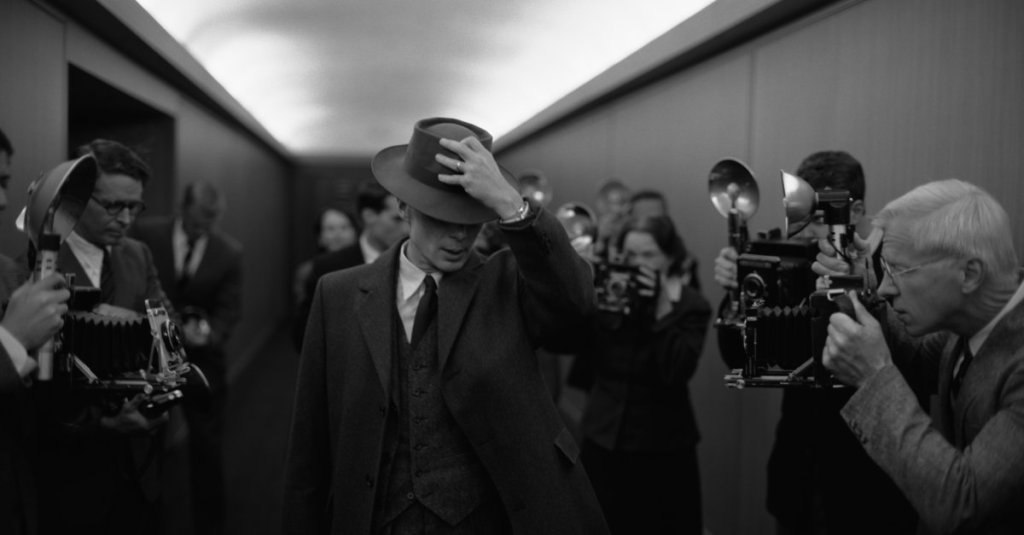
Simply put, Oppenheimer tells the story of J. Robert Oppenheimer in his construction of the atomic bomb during World War II. Of course I use the term “simply” in a much more delicate manner given the fact that nothing is ever simple with Nolan, who finds ways of introducing his penchant for non-linear storytelling into the narrative of Oppenheimer’s life. A natural comparison would be the non-linear structure Citizen Kane as both use the method to attempt to explain the complexities of their respective protagonists. Another comparison Oppenheimer invited which was totally unexpected to me was Oliver Stone’s JFK. Although Oppenheimer never feels as conspiratorial as JFK, both films share a frenetic breakneck pace that make their respective three hour running times fly by. Both films also include sections shot on black-and-white juxtaposed with sections shot in color, which reminded me of Robert Richardson’s cinematography from JFK, and that’s something I welcome greatly.
The man himself is played by Cillian Murphy, making this his sixth collaboration with Nolan and his first turn as the lead actor. It is a monumental task for any actor to carry the weight of both this particular character and this subject matter on their shoulders but Murphy proves more than up for the challenge, which should be no surprise given his remarkable track record. Another superb performance in this film is Robert Downey, Jr. as Lewis Strauss, who effectively becomes Oppenheimer’s nemesis. He is the Salieri to Oppenheimer’s Mozart (a comparison Nolan made himself Murphy and Downey in preparation for their roles) and Downey Jr. is superb. He completely immerses himself in the role, reminds us of what a good actor he is, and it just feels great to see him in a non-Marvel film, non-Tony Stark role. It seems as if it was ages ago since he got the chance to “act” and be a fully fleshed out character that does not rely on his stock-standard sarcastic attitude.
If I were to provide a criticism of Oppenheimer, it would most likely be the portrayal of the female characters portrayed by Florence Pugh and Emily Blunt, which has more to do with their limited screen time, but in the case of Blunt has slightly more to do with her characterization. But given that this is a film called Oppenheimer, I feel that it is a fairly slight criticism as the film is still superb on every possible front. The aforementioned cinematography by Hoyte van Hoytema captured on IMAX 70mm film stock (I managed to watch it on 70mm and it was incredible to see it that way), Jennifer Lame’s razor-sharp editing keeping both the pace and different narrative timelines in the clear, Ludwig Göransson’s score which uses the string both in themes and motifs that sound inspirational and at times sound more reminiscent to a Penderecki piece of pure horror given the ramifications the atom bomb will have on the world. Ruth De Jong’s first collaboration with Nolan as production designer sees her create a living, breathing world through the sets which include a full scale recreation of Los Alamos that feels time accurate and lived in. And in conjunction with the score, the sound design is amazing, especially during the recreation of the Trinity test, which is both shocking and inspired at the same time, yielding both awe and horror.
It feels futile to say at this point but Nolan has done it again and delivered yet another fantastic film. Even if I don’t think Oppenheimer will top either Dunkirk or Inception as my favorite Nolan films that only speaks to his remarkable consistency as a filmmaker who to my eyes constantly hit it out of the park, more so than most filmmakers today I can think of.
In 1945, Julius Robert Oppenheimer became Death, the destroyer of worlds. And in 2023, as we see his life unfurled before us through the lens of a modern visionary, we are reminded once more that we forever remain the inheritors of that world.
 A Fistful of Film