The new film by acclaimed American filmmaker Martin Scorcese is in cinemas, rejoice! If the point of a review is to tell if you should spend your £15 to go see a movie it should really end there. The new film by Martin Scorcese is a grown up, three and a half hour epic that cost upwards of $200m. Martin Scorcese also happens to be one of the best filmmakers alive with a career spanning five decades. A pioneer in New Hollywood, Martin Scorcese continued through the 80s and until now putting out films that not only challenged people’s preconceptions of what mainstream American cinema looked like, but what Scorcese was capable of. It’s easy to forget he has one of the most diverse filmographies in American cinema. Therefore, if a review should convince you whether to go to see a movie or not, (after all, you, the reader, only have so much money to spend), consider this is a big movie, of the kind we don’t really get in cinemas anymore, that takes on complicated themes that cost a lot of money. If any film needed your financial support this weekend this is the obvious choice. It also happens to be exceptional, and maybe, even, Scorcese’s best work to date.
Of course Killers of the Flower Moon will be just fine whether people turn out for it or not. The fact it has registered the second best opening for a Scorcese film ever is encouraging. The fact that nearly half of those who saw it on the opening weekend were young people, the life blood of cinemas because they have disposable income but not jobs, also encouraging. However this film was not made for cinemas, ultimately it will be mostly viewed on Apple TV who put up the money in collaboration with Paramount. Streaming services don’t care how much stuff costs because they don’t make their money through ticket sales but monthly subscriptions. Even Cleopatra managed to eventually break even during the era of video rentals because people kept renting it. There is a similar idea at play in streaming, if something brings in new subscribers, the logic of the streamers is that in the fullness of time, any title will pay for itself with recurring subscriptions. It’s passive income but for movies. This has enabled the movie to be the movie that it is but it may also hinder people from getting the full experience. Such a long film will probably be viewed by most people across multiple days, with breaks to pee and make tea and your kids running through the living room and the dog barking and your sister calling after her new old boyfriend broke up with her for the eleventh time, and really that’s no way to watch a movie at the best of times, let alone this one. This is a film that demands the big screen, and I demand you take the time and the bum-ache to go see it. Let me explain why.
For a start, more so than almost all of Scorcese’s back catalogue, which is saying a lot, this has real big screen splendor. The film, based on one of the most celebrated true crime books of the last decade which goes by the same name, centers around the Native American tribe of the Osage Nation. Fronting up about the racist history of expansionism, the preface of the movie makes clear these people were forced off their land onto thought unworkable soil, until they discovered oil and struck it rich. Subsequently the film has a similar approach to filming the great American expanse to There Will Be Blood. The land appears monstrous, it burns and ripples and is beat and sowed and tilled in ways that feel monumental. When you strike down with a grape hoe, you are ripping apart a living beast well beyond your comprehension. The oil the film centers around springs forth like the earth’s blood from a wound. This ties into the larger themes, weirdly, of cultural erasure. The film opens with tribal elders mourning the inevitable loss of their culture and it comes true. As the earth is exploited for capitalist gain, the money invites in the white settlers, and theirs becomes a dominant mode of culture. This is even before the murders that drive the narrative of the film.
Before we get into the film proper, it is important for the writer to lay out their bonafides. I am not Native American, I’m not even American. I am British, and white. I will do my level best to not fuck anything up but my understanding of the cultures this film centers on is never going to be the most complete version you could get. I do know about movies and I’m going to try to write with sincerity and integrity about this one.
The plot kicks into gear when Ernest, played by Leonardo DiCaprio, comes home from war in 1921, where his uncle, played by Robert De Niro, encourages him to go get some of the oil money by marrying one of the Osage women. It is later revealed that De Niro’s character is a Freemason, and necessarily, in the pursuit for Osage money his machinations get darker and darker from a point of already being incredibly dark to start with. As the necessities of De Niro’s scheme to make the money trickle to him, he causes all roads to necessarily lead to him, and covering his tracks gets more and more bloody. As Jesse Plemons’ detective character calls it, there becomes an epidemic of murder of Native women in Osage. The FBI isn’t really a thing at the start of the story, and it is it’s creation that is the thing the criminals don’t see coming.
Necessarily, DiCaprio’s character has to be quite a weak man, this is not something we have seen him do a whole lot. Jordan Belford was, in many ways, as played by DiCaprio, a weak man, but DiCaprio plays Belford with bluster. Belford was someone who unblinkingly said yes to every exploitative choice put in front of him, whereas Killers of the Flower Moon’s Ernest is someone who is weak willed, who does not push for things. DiCaprio plays this kind of character brilliantly. When someone has convinced him he’s in the right he is like a pig in shit but when he has to hide and skulk, or more commonly when someone sees through him, sees how pathetic he is, he shrinks visibly. It’s like DiCaprio makes his whole body skeletal. He also plays the central double-think of the character really well, thinking he is a loving husband while conspiring to wipe out his wife’s family, ultimately. This dynamic could come off as a schism in the film, as something that doesn’t make sense, a plot hole, if it weren’t for how well DiCaprio plays the nuances of the character. Bob De Niro clearly loves playing his role and I would say he’s already nailed on as the leader of the pack in the supporting actor race at the Academy Awards this year.
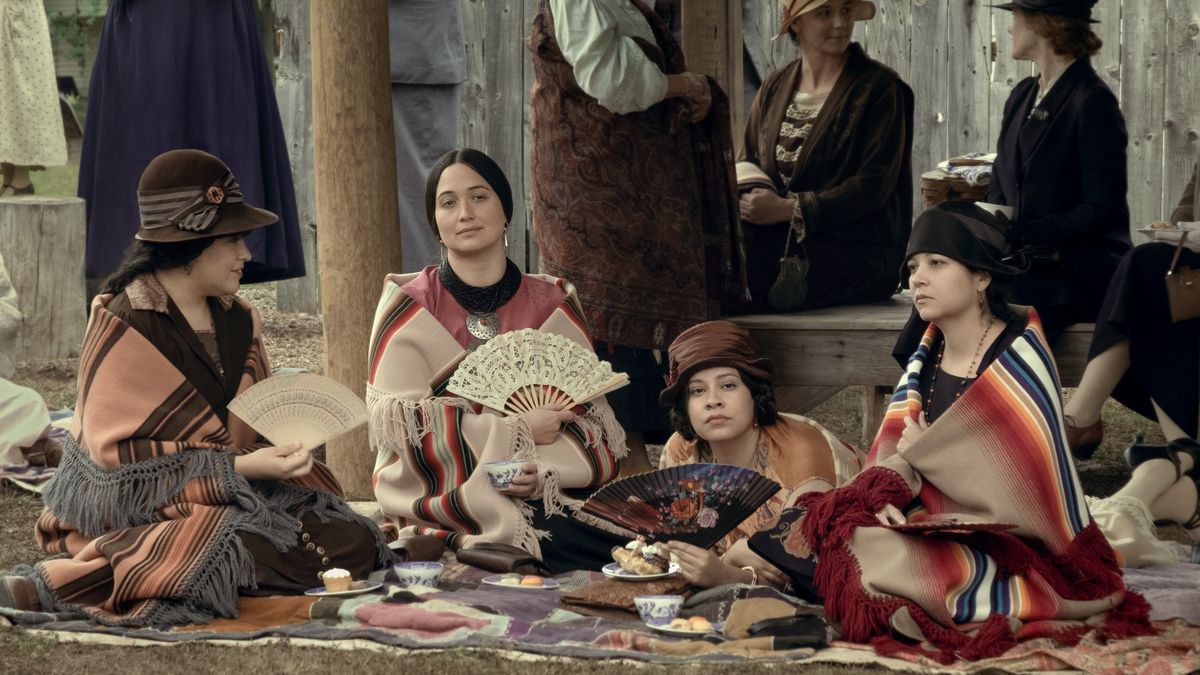
The real star of the show, though, is Lily Gladstone. After a small but movie stealing role opposite Kirsten Steward in Kelly Reichardt’s domestic masterpiece Certain Women, Lily Gladstone arrives on cinema’s biggest stage as if she always belonged there, as if she’s been leading major motion pictures for decades. It is truly impossible to understate the monumental nature of her performance. The reason it seems so accomplished is the extent to which it is underplayed. Mark Kermode said of the spy film Tinker Tailor Soldier Spy that it were as if that picture’s incredible cast of actors all got in a competition to outdo each other by underplaying it, and there are shades of that for Gladstone. DiCaprio and De Niro are both giving quite big performances, (especially DiCaprio constantly doing that frankly rather annoying ‘furrowing of the brows’ acting tik he always does), but Gladstone tones it right down. At the beginning of the film De Niro has a speech about how the Osage tribe refer to a kind of bird talk that white people do when there’s nothing to say and sound hangs empty for a moment so people fill it with needless chatter. I know exactly what he’s talking about because I do it all the time. The phrase was ringing around in my head whenever Gladstone was on screen because while she does not have a lot of dialogue, her eyes do so much talking. She has a way of looking at a character where not only do you know she thinks she knows the truth of a situation, you know she absolutely does know the truth of a situation. She cuts through and cuts down without many words at all. I think a lot of actors when they’re young feel like they have to be doing everything all the time, they have to constantly be selling, but an experienced actor knows how much they can do by just being, and Lily Gladstone constantly is.
It is at this point I feel it is necessary to address some of the critiques the film has had, especially from Native Americans and Osage peoples. While it is true that very early on in the film’s festival tours an Osage ex-chief composed a very long Twitter thread on the dignity the Osage is given and the need to tell the stories of their history that tell us how racist beliefs and actions became racist systems, but not everyone agrees. As an interjection, I would also add that in this story people wanted money and capital and their racism was the way they let themselves off the hook for fucking people over in ways they always wanted to, and the film does not pussyfoot around that. However, there have been a lot of people coming out to say, both publicly in magazines, and privately amongst conversations with my friends and I, that they are Natives who have problems with the film. The real thrust of it seems to be that this is the story of the white oppressors, that this is the story of the murderers, and not the story of the Osage peoples, and while this is both true and not true to varying extents, it is definitely true that this is a film where the majority of the screen time is taken up with the white people.
The language consultant for the film, Christopher Cote, came out to say that the film tries to portray love between DiCaprio’s and Gladstone’s characters and there could not be any love in a relationship where one person sets out to massacre their partner’s family for money. I agree with him but I think the film does make it clear the hypocrisy of DiCaprio’s way of seeing the world. I think it makes clear the extent to which DiCaprio goes to almost farcical lengths to rationalize his actions. He has convinced himself his love is genuine but maybe he cannot actually feel love, so he genuinely believes he loves his wife but in fact, he is just as sociopathic and money hungry and okay with blood and murder as De Niro’s character, but he’s just a weaker, smaller man. That’s my read on the character but I also think the criticism of the movie I have referred to are reasonable and valid and not not there. I would also refer you to my bonafides as previously referred to, my perspective is one of someone alien to these cultures, and I cannot speak on them with any authority. So please take what I’m saying with as much salt as you feel entitled to. Christopher Cote also suggested that only an Osage could have told the story the way he would maybe have wanted it to be told, and here is really the problem with Killers of the Flower Moon, and it is an industrial one. I can, off the top of my head, think of two movies directed by Native Americans, and one of them is a documentary. It is not that it is wrong that Scorcese told this story this way, but it is wrong that there are no alternatives. Scorcese’s telling of this story is aching and angry and beautiful, as it should be, but it is definitely a problem that this story was not already told by an Osage.
Scorsese, I think, does do a good job of telling this story though. Over three and a half hours, I felt the time was well used and I never felt it was slow. Whereas Silence is a very slow film because it is a delicate film about the fragility of the things we define ourselves around, and The Irishman actively wants you to feel yourself aging over its runtime, correctly I think, Killers of the Flower Moon never feels slow or baggy. People have suggested that this film may work better as four one hour episodes of a miniseries, people I respect have said this, and I find it a disgusting suggestion. I cannot tell you how many miniseries I have given up on because it should have just been a long film, and in a streaming miniseries context, things get baggy and languorous and ponderous. It makes me ache when I watcha 6 hour miniseries that should have been a four hour movie, and I ache because we don’t let filmmakers make long films that feel like they can take their own time anymore and thus they have to make boring long television. We have a movie here where one of the greatest filmmakers ever has been allowed to make a film exactly as long as he wants and when the film gets slow and atmospheric and ponderous it is because it wants to be and it works. It is part of a whole package in which every decision is accountable to every other. The only time I even ever noticed it getting slow was toward the end when we are expected to sit in the horror of what is unfolding, we are expected to look into flames slowly and see fire. We sit and wait for the void to look back into us.
Scorcese tells this story with the rage it necessitates. It is a deeply sad film, filled to brim with pain that it makes you feel as a viewer. It is gut wrenching and mournful. It is mournful for all the people lost, all the cultures lost, all the stupid waste of it all. It looks at this event that did not have to happen but for the stupidity and ignorance and greed of racist men, and it screams in a harrowing wail of sadness for what is lost and can never come back. When I left this film I wandered around the local mall in which I saw it feeling empty, crying as I did my groceries, so profoundly affected especially by the way Scorcese ends the picture which hammers home with grim dark humor and metatextual manipulation of the medium not only the horrible waste of a whole people, but the flippant way these stories have been forgotten and trivialized over time.
This is not to say that this is just a three hour feel-bad fest, although it is very much a film that will make you feel bad. It is a film filled with a lot of grim dark humor lifted directly from reality that made me laugh in spite of myself in the theater, but it was a grim, dark laugh. It also has an incredible score from the late, great Robbie Robertson of The Band who previously worked in many capacities with Scorcese, (who, incidentally, is Mohawk himself). His score for Killers of the Flower Moon is bluesy and bluegrass and steely and threatening. There is little orchestration but lots of steel guitar and bass and drums. It’s wonderful and you will be listening to it separately to the film guaranteed.
This is, I think, Scorcese’s new best film. As he ages, he increases in scope of what he wants to say. His appreciation for the world has deepened as have his films. The joy of his old films were, at least to some extent, their pop appeal. Even when dealing in heavy subject matter Marty knows how to make a film slick and finger snapping and have it move in a certain way. This film is only ever like that when it needs to be in party with everything else. The main tenor of this film is a huge well of darkness that sits at the edge of all events, slowly encroaching. This is Scorcese continuing to push forward not only himself but the medium, and it will be remembered, justly, as a towering achievement in his career. To make a lazy comparison this is his Ran, as a result I think we would all love to see his Dreams.
 A Fistful of Film