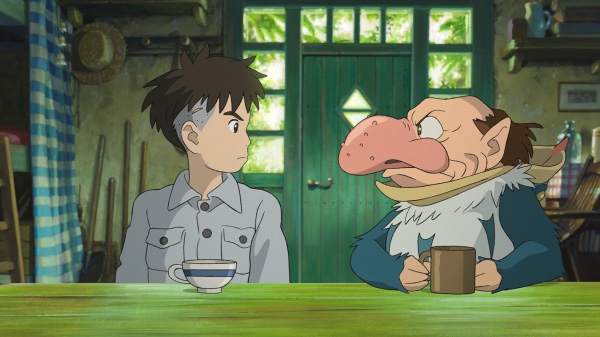
In the year 2023; the guys had Oppenheimer, the girls had Barbie, and the weebs have The Boy and The Heron. Miyazaki’s return to directing (not including his short films) after a 10 year absence, and his third “final” film (which yet again he has U-turned on with the announcement of a new project). But the other aspect of The Boy and the Heron which a lot of media outlets aren’t highlighting, is that this is Miyazaki’s first film since the passing of Isao Takahata, the co-founder of Studio Ghibli that died in 2018. For me, The Boy and the Heron is heavily influenced by Takahata’s passing and Miyazaki’s journey through grief.
The Boy and the Heron is, to me, a companion piece to Spirited Away as both follow similar narrative beats; while exploring different topics. Spirited Away is about a young girl’s journey through a strange world while coming to terms with the confusion and fear of isolation after her parents are transformed into pigs, it can be seen as a parable about the transition into adolescence and being thrown into the world and its challenges unexpectedly. Meanwhile The Boy and the Heron is about a young man being thrown into a magical world as he struggles with the grief and loss of his mother who dies in the firebombing of Japan during the second world war. Both use the magical worlds as metaphors for a journey through confusing, challenging and overwhelming emotions that force the characters to confront their emotions. Spirited Away can be seen as Miyazaki, who often uses fantasy to impart knowledge and wisdom to his predominantly younger audiences, as a story about accepting the challenges that come with growing up. While The Boy and the Heron is similarly very much a story about grief and learning to live and survive rather than caving into the turmoil that losing someone can bring.
This is why I say that Takahata’s passing is so important as context for the film, because Miyazaki uses the film not only to impart these messages to the audience, but also as a conduit for his own process. Our main character is given the choice to retreat permanently to the magical world, becoming a creator striving for utopia, or returning to the real world and facing the struggles that come with life. This conundrum can be seen through Miyazaki as a creator himself, the idea of retreating into his work, rejecting life and focusing solely on work instead of accepting the passing of a close friend. But this idea also works for the larger audience, as since the beginning of production for this film in 2016, a pretty major event impacted people across the globe: the Covid-19 pandemic. Now this might sound like a leap on my part, but this event saw countless people lose friends, family members and loved ones, and for a long time forced a large population of the world into their homes with nothing to distract themselves with apart from TV shows, Movies and Video Games. While this isn’t a bad thing, don’t get me wrong I love all of those things, the impact it had on people’s mental health and ability to socialize is already manifesting itself. The rejection of retreating into fictional lands and instead embracing life, embracing hardship and embracing struggle is now a universal message, in the same way Spirited Away’s message of growing up, independence and continuing to fight through life’s struggles was in 2001.
Miyazaki’s style is instantly recognisable, so much so that when people think of Studio Ghibli they think of Miyazaki (and often ignoring the brilliance of Takahata’s more fluid style of animation). At first The Boy and the Heron seems no different in terms of its art, echoing all of Miyazaki’s previous films. But from the very start we see that Miyazaki has developed his form. The film opens with a bombing of Tokyo that sets ablaze the hospital where our protagonist’s mother is. Mahito, ignores his fathers instruction to stay at home and runs through the burning streets of Tokyo, with the naive belief that he can do something to save his mum. What instantly jumps out to me is how the burning surroundings are animated, the fire has a beautifully kinetic quality that is quite unlike anything we’ve seen Miyazaki do. But it doesn’t even stop there, the scene devolves into what can only be described as a nightmare. As the dark Tokyo night is illuminated only by the dancing flames enveloping Mahito as the contorted faces of citizens flash across the boundaries of the scene, becoming ghoulish figures that reflect the horror of these bombings but also represent Mahito’s own fears. Obviously, this scene mirrors Grave of the Fireflies (which again is more proof to me that this film needs to be understood within the context of Takahata and his passing), but how Miyazaki approaches the scene feels closer to Barefoot Gen’s atomic bomb scene. It’s probably the closest we will ever get to Miyazaki making a horror film and to open the film with this sequence is a bold and potent move. But even in the fantastical scenes, there is a clear evolution of Miyazaki’s art, despite its clear continuation from the same veins of Spirited Away & Ponyo in its approach to movement and wonder. The Boy and the Heron is so filled with movement and kineticism which you can compare to Porco Rosso, which my main criticism of is how so much of the animation is stilted and the heavy use of still frames. When you get to the scenes with the Parakeets (which are amazing by the way) you can look anywhere on the screen and there’s an infectious fan that comes with the little bits of movement and what the background characters are doing. But throughout the film there are so many gorgeous set-pieces that show that Miyazaki isn’t resting on his laurels but furthering the advancements in animation that made him such a powerhouse to begin with.
I haven’t touched on the story that much, but I think it’s better this way. The film premiered in Japan with little fanfare, and the only marketing being the hand-drawn poster. While I could easily wax lyrically about the plot, I feel it’s best to go into the film as Ghibli intended. This being that you should know as little as possible so that you can experience the journey Mahito undertakes with the same naivety and wonder that the character feels. This film feels like it draws its influences from all of Miyazaki’s greatest hits, you’ll see shades of most of his films throughout but it’s central narrative is new, vibrant and touching. The second time I’ve seen a brand new Miyazaki film in cinema, but unlike The Wind Rises which is very unique in his filmography, The Boy and the Heron conjures up the magic of watching Spirited Away, Nausicaä and Castle in the Sky for the first time. Whether this does end up being Miyazaki’s last film or if we do get to see the finished product of his new project, The Boy and the Heron is another feather in the cap of a filmmaker who will go down in history as one of the all-time great directors.
 A Fistful of Film
One thought on “The Boy and The Heron (2023) – A Whimsical Meditation on Grief”