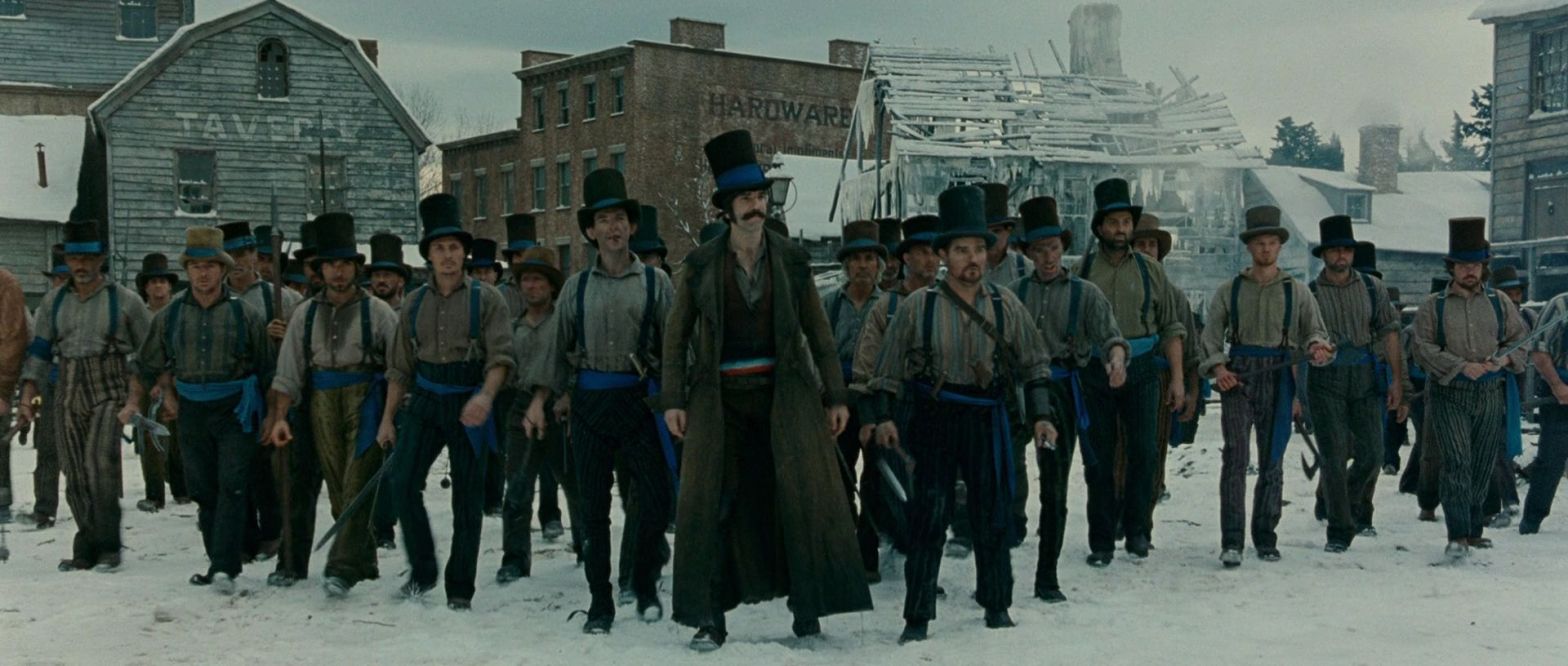
In 1977, following the critical and commercial success of his previous three films Mean Streets, Alice Doesn’t Live Here Anymore and the Palme d’Or-winning Taxi Driver, a 35-year old Martin Scorsese announced the title of his next project: Gangs of New York, a historical epic about his hometown, New York City and the Five Points neighborhood in particular. Later that year however, Scorsese’s first big-budget project, the revisionist musical New York, New York bombed heavily at the box office and took its near fatal toll on the director. Moving around in a transitional period in Hollywood where auteurs were no longer in demand, the likelihood of such an expensive undertaking as Gangs of New York dimmed ever so slightly, especially when the failure of the costly Heaven’s Gate made Hollywood studios turn their backs on historical epics. Despite these gloomy years, Scorsese never let go of the idea of Gangs. When he wasn’t directing another picture he would research or develop an original screenplay with his old friend and frequent collaborator Jay Cocks. By the 1990s though, it looked as if the project was picking up steam as the project finally found its footing with stars Leonardo DiCaprio and Daniel Day-Lewis attached to play the two male leads, and finding a home at Miramax, run by now disgraced movie mogul Harvey Weinstein. But that was also where a lot of the trouble with the project started.
The production of Gangs of New York was anything but smooth, going several weeks over-schedule and almost doubled its initial $65 million budget reaching the heights of somewhere in the area of $100 million, the biggest of Scorsese’s career (up to that point). Even before production had commenced there were numerous drafts of the script floating around done by various other screenwriters of note including Steven Zaillian and Kenneth Lonergan. Hossein Amini helped out with an additional two drafts before production started, although he ultimately went uncredited. In addition to the screenplay, New York itself proved an impractical shooting location, by virtue of it simply being too modern looking. No way it could pass for 1860s New York slums. Thus the decision was made to instead shoot at the Cinecittà studios in Rome with sets built by production designer Dante Ferretti. Then there was the issue of Scorsese’s vision for the film versus Weinstein’s vision. Weinstein aimed for a more commercial and streamlined picture under two hours. But that wasn’t what Scorsese had in mind. Oh no he was going to pull no punches and go all in with a near three-hour runtime and a vast canvas.
Covering those three hours of material is the story of Gangs of New York, which is one of the first bones of contention some people have with the film, in that it is a rather conventional story by Scorsese’s standards. Following a gang conflict on the streets of the Five Points slum in New York City in 1846 (which is a spectacular set piece in my opinion), young Amsterdam Vallon witnesses his father, leader of the Irish-American gang Dead Rabbits Priest Vallon (Liam Neeson) be killed by rival gang leader, the Nativist Bill “The Butcher” Cutting (Daniel Day-Lewis). Sixteen years later in 1863 in the midst of the ongoing American Civil War, Amsterdam has grown up into Leonardo DiCaprio and returns to the Five Points to seek vengeance on “The Butcher”. In the meanwhile we meet a collection of fascinating array of supporting roles played by exceptionally gifted character actors, such as the corrupt politician Boss William Tweed (Jim Broadbent), the lowlife thugs Johnny (Henry Thomas) and Shang (Stephen Graham), the former members of the Dead Rabbits gang cop Happy Jack Mulraney (John C. Reilly), McGloin (Gary Lewis) and Hell-Cat Maggie (Cara Seymour) and the mysterious Walter “Monk” McGinn (Brendan Gleeson). Oh and there’s also a thief called Jenny Everdean (Cameron Diaz). Tweed also has an assistant named Killoran (Eddie Marsan).
Gangs of New York is big with a capital B, which could also stand for bloated if you belong to the camp that dislikes this movie. It was going to be an urban western, or as Scorsese liked to call it an ”eastern.” There is an inherent danger with having a big vision of an ”epic film” that it could very well be too great and run away from you, leaving you with a half-fulfilled and unsatisfactory. In the eyes of some that is seemingly what happened to Scorsese on Gangs of New York, as many find it narratively lacking (despite four top of the range screenwriters working on it), bad casting choices in the shape of Cameron Diaz and even worse accents, again with Cameron Diaz. Whilst Gangs of New York is no perfect picture, I still hold it in high regard as I believe it is a much more profound meditation on violence and society than most of its critics would argue.
It could very well be a case of me looking back nostalgically to my first viewing of Gangs. I was merely two years old when it came out but by the time I was in my teens I remember commercials for it on tv as the channel was showing it and it caught my attention immediately as a fan of history and movies in general. It didn’t look like my expectation of what a historical movie should look like because I thought it actually looked cool (keep in mind I was like fifteen at this time). It may very well have been the first Scorsese movie I ever heard of or actively sought out. When I finally did watch it I remember being taken by the majesty and scope of the film, as well as the level of detail present in the art direction and costume design, as well as the unusual and eclectic choice of music for the film. So this movie had me from the get-go. And my most recent viewing, whilst still revealing numerous flaws that have not aged as well as my recollection would have it (the voice over in particular felt slapped on and the first half hour feels terribly rushed) but despite all these years the film still hooked me in.
What I think makes Gangs of New York special, perhaps only to me, is how it depicts a whole other world that is as alien to me as the world of Arrakis in Dune or Tatooine in Star Wars. So much careful detail is spent on the costumes, the names of the gangs, the look of buildings and objects that I’m shocked the film didn’t go home with at least any Oscars for art direction or costumes. But as colorful as the backdrop often is and is (rightfully in my eyes) given as much focus as the foreground, the foreground is still the story of Amsterdam’s vengeance, which I find engaging. Now am I saying Leonardo DiCaprio’s performance is as arresting as Daniel Day-Lewis? Of course not, Day-Lewis and the film truly come alive whenever he pops up on screen. But that doesn’t mean I find Amsterdam’s story or the story’s connections with the New York draft riots in 1863 unsatisfactory. I used to be of the opinion that it was slightly anticlimactic that we didn’t get another full on gang brawl to match the one in the prologue, but as I get older I find it much more appropriate that it should be interrupted by the draft riots in such a drastic way. We are literally watching a way of life get swept away here. In modern America there will be no room for such clan leaders as Bill the Butcher who will shed as much bloodshed as he does in such public arenas. The ways of old are being replaced by the notion of diplomacy and democracy. Which brings to mind the closing voice-over which I find to be the most appropriate use of the voice-over that in a way sums up the entire film: ”But for those of us who lived and died in them furious days, it was like everything we knew was mightily swept away. And no matter what they did to build this city up again… for the rest of time… it would be like no one ever knew we were even here.” As these words linger in our minds and the U2 song ‘The Hands That Built America’ kick in, we witness a haunting montage of various tombstones slowly crumble as New York of today rise out of the ashes of those hectic months in 1863. Just like the epilogue from Barry Lyndon, whether they be rich or poor, Irish or black, Catholic or Protestant, they are all equal now.
For the longest time Gangs of New York was Scorsese’s great white whale, the epic to end his epic projects. But as time has gone on time has seemingly forgotten about this film, and when looked back upon its seen as more of a footnote in an otherwise transcendental career trajectory for Scorsese. I’m happy Scorsese is still making films that garner critical attention and gain plenty of new fans, but I’d be lying if I said it doesn’t make me a little sad that Gangs has seemingly fallen to the wayside. This may not be the popular opinion, but I will remain a firm defender of Gangs of New York as a legitimately great film and I believe it is due for a reevaluation. And while we’re at it: ”Marty, Kundun! I liked it!”
 A Fistful of Film