Sweden has a fascinating history that has yet to reveal itself on screen in cinema. There are naturally a handful of films that depict Swedish history. For instance Ingmar Bergman’s The Seventh Seal and The Virgin Spring depict medieval Sweden when religious turmoil and the plague tormented the countryside. Greta Garbo played Queen Christina in a Hollywood production from 1933 which changes the history of one of our most complicated and recognizable monarchs into a standard princess-in-love story. Jan Troell and Bo Widerberg have both depicted various historical and dramatic moments from our recent past in the 20th century, such as the Ådalen shootings and the mass emigration to America. Although this seems like a fairly long list, there is a general feeling amongst myself and friends that there is much fascinating history in our country that is still unexplored in film. A highly dramatic event from the 16th century was the event known as Stockholm bloodbath, in which the Danish king Christian II ordered the execution of 100 Swedish nobles despite having recently pardoned them, in an attempt to crush any resistance left to the Kalmar Union. This did not have the intended effect, as the Swedes rebelled in retaliation and under the leadership of future king Gustav Vasa Sweden liberated itself from Christian II:s rule, and he has ever since been referred to as Christian the Tyrant in Sweden. As you can understand from reading this, this is a major episode in the history of my country. Now this episode has been brought to life in a major new motion picture simply titled Stockholm Bloodbath. But not only does it fail to do justice to the actual events, it fails utterly on every conceivable level and I strongly believe it might be one of the worst things I’ve seen in a long while.
Stockholm Bloodbath is a major investment from Swedish streaming giant Viaplay in their attempt to create original films. In an attempt to reach a wider audience worldwide, all actors speak English instead of Danish or Swedish, including the actors for whom these languages are their mother tongue. So right from the get go this is no good sign, because it smacks the audience in the face with a lack of authenticity that we expect from a film regarding this sensitive topic. And with such recent films as Parasite from South Korea, Roma from Mexico and The Worst Person in the World from Norway reaching an international audience despite retaining their original languages and cultural specificities, it feels even more foolish to somehow think that an anglo-speaking audience will be more attuned to this film just so they won’t have to read subtitles. It is frankly insulting that we in the Scandinavian market seem to be the last people the filmmakers concerned themselves with when making this film when we should be the target audience. Had this film been a Hollywood production it would’ve been a completely different matter but this is a Scandinavian production with a Swedish director and Norwegian screenwriters. I understand their logic, but at the same time I think it is vile, soulless and ghastly beyond belief.
The tone itself is also all over the place. Before seeing the film I read other reviews for the film that compared it to Ridley Scott, which seemed reasonable given his preoccupation for historical epics such as this, but many also name dropped Guy Ritchie and Quentin Tarantino as influences. When I heard of that my heart sank even deeper because I more or less knew what that would entail, or so I thought. In truth it’s actually much worse. And just in the first five minutes I had already facepalmed six times at what was being shown on screen. There are freeze frames throughout the film that spell out the name of every single character and their role in the story, which just feels like such a lazy way to introduce these very important characters to us, whether or not they’re fictitious or really existed. The film also employs split screen on various other occasions. Split screens themselves are an interesting cinematic device that could be utilized well, but here it felt as if it was done to make the action look “cool” and “stylish” but precisely for that it comes across as stupid. And the Tarantino connection is even worse because one of the main female characters writes up a list of the men that were responsible for massacring her family before the bloodbath itself. You know, just like Kill Bill. Then she trains to be an archer in a two minute montage that has no payoff other than using a crossbow to kill two completely insignificant characters towards the end. After the first five minutes I turned to my friends that I saw the film with and said: “I hate this film.” And there was still another two hours and twenty minutes to go, and the worst was yet to come.
Now if I were to tell you that one of the female characters proclaims to another “let’s have a day just for us girls with spa and new dresses” in a historical epic about one of the most violent moments in Swedish history, I think you’d say I was joking. Oh if only it were so. This is something that Lady Christina Gyllenstierna proposes to her cousin Anne after the Danes have started to besiege Stockholm. Now I’m no expert but I’m not certain that spas like this exactly were a thing in 1520, and it feels out of character for someone who keeps proclaiming how incompetent men are at the government and causing all the trouble. Maybe you should be concerned with your population who surely must be terrified at the thought of besiegement and all that entails. I’m sure this is all meant to give a feminist slant to the events but it comes across as insulting because it seems to equate feminism with simply talking about how men suck and how girls are better because…I dunno? I’m not suggesting to be an expert on feminist philosophy but I’m pretty sure it amounts to more than going “look at how awful things are because of men” every five minutes.
There is also a dance sequence in this film because of course there is, and it is set to a modern pop song because presumably the director has seen Moulin Rouge and Marie Antoinette, and it involves women standing in line dancing in a very suggestive manner then cutting to various couples having rough sex all around the castle. Now why does this happen? Beats me, it doesn’t add anything to the story and it doesn’t provide any further interest in the plot, it just strikes me yet again as the filmmakers trying desperately to come across as cool and stylish but failing so miserably I start to worry for their well being. I think even Baz Luhrmann would go “hang on there mate, I don’t think that works” if he were to see the way the pop song is used in this film.
On that note let’s discuss what is arguably the best aspect of the film, namely Claes Bang’s performance as Christian the Tyrant. Claes Bang plays Christian less as a real historical figure and dramatic character and more as a cartoonish bad guy who isn’t in the least bit frightening or intimidating. His performance is so goofy and over-the-top that I suspect this might’ve been a similar situation to Alan Rickman in Robin Hood: Prince of Thieves, where he found the script uninspired but agreed to do it if they agreed to give him the freedom to play the part as he pleased. If that is the case then I say good for Claes. If the script he’s provided with is below his standards as an actor then frankly why should we even expect him to bother us with a good performance?
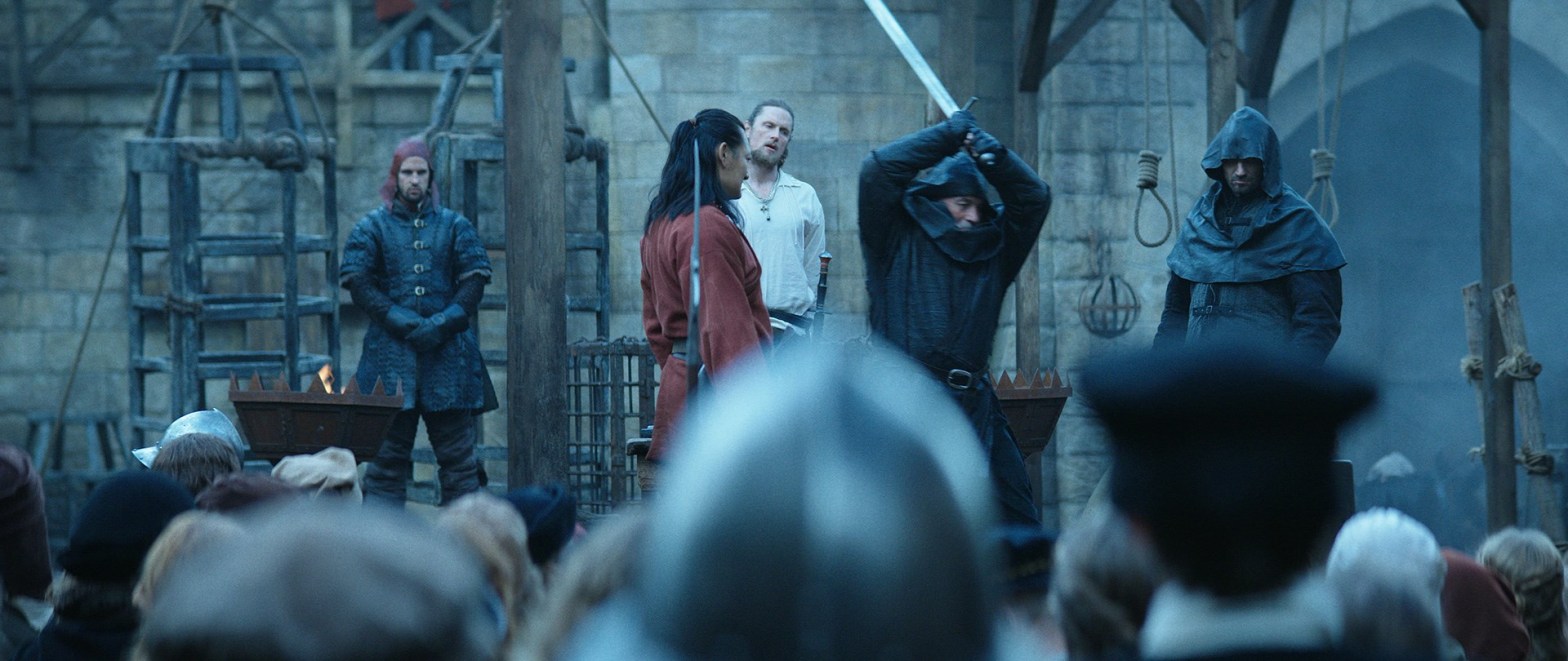
Now maybe we should discuss the main topic of this film, the titular Stockholm bloodbath. You would think that a film that is literally named after the event it is depicting would try to do a decent portrayal of the historical event and finally deliver the cinematic goods, but it fails spectacularly even here. The square it takes place on looks like the set of a tv show because of how small it is, nothing like the actual square where it took place. The main Dane responsible for the massacre, Dedrik Slagheck, is portrayed as a comical villain who just screams every line from the top of his lungs and proceeds to do a weird Bollywood-style dance in the rain when it continues into the night, supposedly to suggest his madness but he just looks like a buffoon. I have to tell you, there were several moments like this that made me and my friends laugh, but I’m not sure that was the filmmakers goal. And even if it was, I frankly don’t want to see a darkly comical version of these events. Since I care very much about history and it being portrayed accurately I would rather see a straightforward dramatic retelling than whatever this piece of garbage tries to produce. It would both honor the victims and it would be something we as an audience deserve. We deserve to be taken seriously instead of being treated as morons who think everything has to be ironic or cool.
In case you couldn’t tell, I truly hated this film. I see so much potential in a film about one of the most dramatic moments in our history and it could’ve been a grand epic in the style of Braveheart or Gangs of New York but we blew it just to appease lazy, illiterate idiots. Or at least that must be how Viaplay sees us in the audience, and that might be the worst crime of all.
Oh and one more, final thing before I wrap things up around here: one of my friends had learned there was a post-credit scene in this film because apparently every major movie in a post-MCU world must contain a post-credit scene, even if it is a historical drama. So we sat through all the remaining end credits, hoping it would be something hilariously stupid like Gustav Vasa showing up to clean Sweden up or something to set up a sequel, but instead it was just a stupid punchline that was just annoying. They even messed up something as simple and formulaic as a post-credit scene.
 A Fistful of Film
Sounds rather like the current trend for rewriting history for modern tastes/wokery; Spa days? Ha ha, I’m so glad they could chill out and relax like that back then, lol.
LikeLike