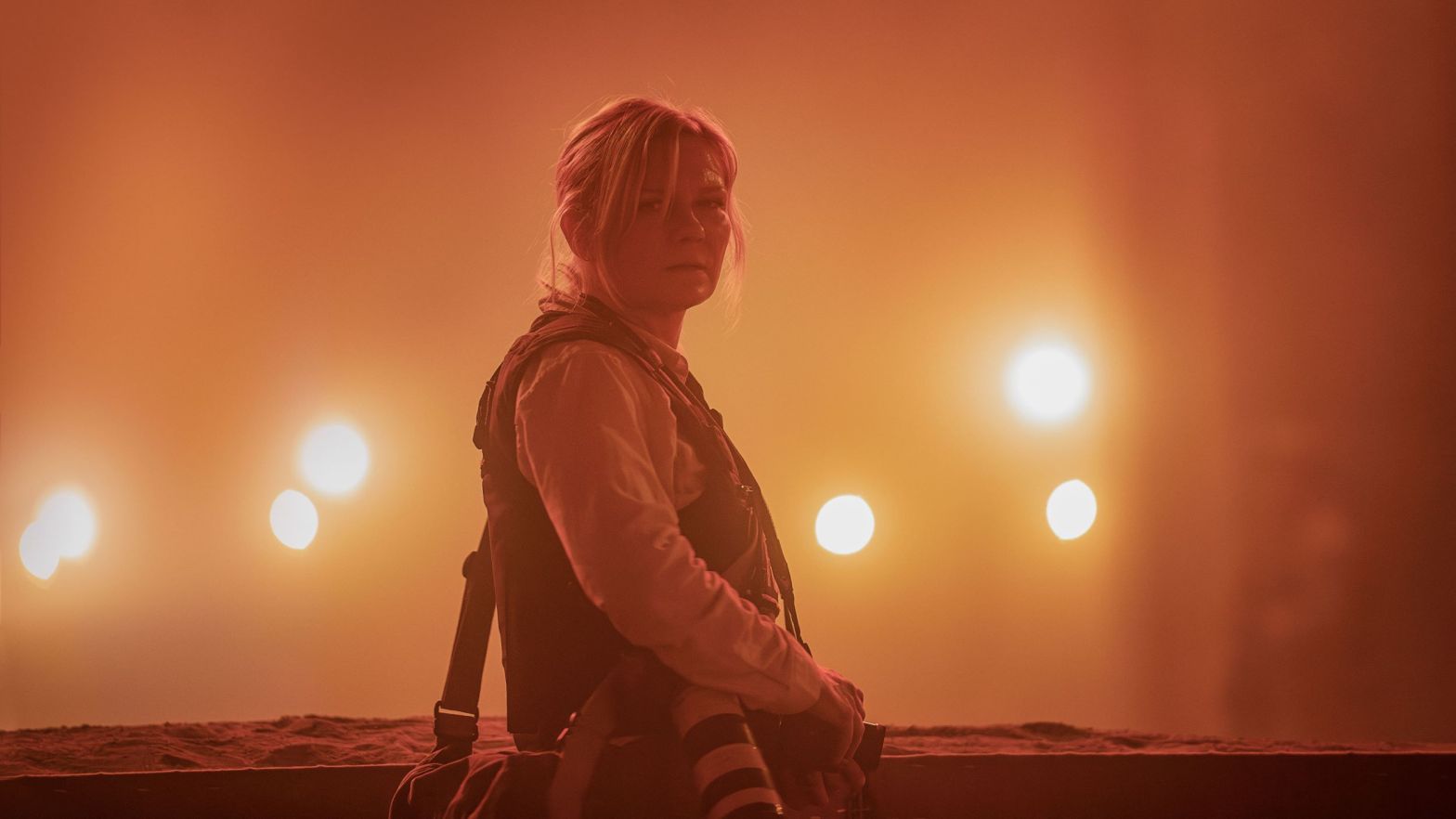
The big question that serves as throughline for Alex Garland’s latest (and possibly last) film: “what is the purpose of war photography?” And it’s a good question. Depending on who you ask, war photography can be seen as adventurous, irresponsible, morally virtuous or morally bankrupt. Some see the profession as pioneers of history, documenting what many would shy away from, while others argue that by being an objective bystander to atrocities, these people are complicit. In Civil War, this is highlighted perfectly in a flashback that Kirsten Dunst’s character experiences where she watches a man get shot at point blank range while his companion is necklaced (a practice that involves a tire being placed around a person before they are set on fire). Dunst’s character takes a picture instead of intervening. The moral quandary is whether it is better to capture this moment for thousands to see and understand the atrocity or to intervene (possibly at the risk of one’s life) to save one individual knowing it is only one of many instances of the same act. And again, this is a question that will be met with different answers from different people, the uncomfortable truth being that there is no one universally “correct” answer.
This ideology of non-intervention from the journalists is present throughout the film, apart from two key moments. One in the film’s best sequence involves Jesse Plemmons’ brilliantly menacing militant, and the other in the film’s climax. Both have important consequences for the characters, but ultimately neither stop the conflict nor the chaos. They’re both acts of supreme humanity, but neither makes a significant difference in the wider conflict. This choice to present these interventions in such context further the exploration of the moral question about the role of an objective bystander.
The other important question the film poses is who is the audience for war photography? In our society, the history of war photography has often been for those who perpetrate the wars. If you consider modern conflicts (Afghanistan, Iraq, Vietnam), the impact of such photography has been felt most in the countries that started the conflicts: America. What Garland does with Civil War is ask how this changes when the conflict is not abroad but perpetuated in the very country that these photos are marketed to. Nothing encapsulates this better than the sequence where our cast of journalists come across a small town seemingly oblivious to the conflict around them. When asked if they are aware of the war, the shopkeeper says that they think it’s best they stay out of it, given what they see on the news. In this exchange the journalists are confronted with the very people they are supposedly providing these battleground reports to. Again Garland asks what is the purpose of this job if ultimately the atrocities of war are ignored by the masses, and even further is there a point to it all if it doesn’t provide any change.
Some of the criticisms I see leveled at the film stem from the characters themselves, and admittedly they are somewhat one-dimensional. I stress somewhat as while it is true we don’t delve into them as much as other films, I would argue this is because their purpose is more representational than for any in depth characterization. What I mean by this is that each of the core cast that we follow reflect different attitudes to the profession, Kirsten Dunst as the most respected but also haggard member is closest to the audience; going through an internal strife about the very questions Garland poses to the audience. Her profession’s purpose, the non-interventionist ideology, all in the hindsight of such a conflict returning to her own country. Wagner Moura’s Joel is more free-spirited and adventurous, it’s clear he’s in this profession for the thrill. This is exacerbated by the fact that he’s constantly smoking weed and drinking when an opportunity presents itself, he’s careful but still seeks the thrills the job offers. Stephen Henderson’s Sammy is a veteran but past his prime; he’s here because he has nothing else, but he doesn’t have the zeal that we imagine he once had, resigned to his fate in light of the lack of opportunities to do anything else. In many ways Sammy is a foresight of what Dunst’s character’s future could look like. Finally, and perhaps most interestingly, is Cailee Spaeny’s Jessie. She’s young, she’s idealistic, and ultimately she’s reckless.
Again, in many ways she represents what we imagine Dunst’s Lee Smith to have been like at the start of her career. She’s symbolic of the future of the profession, but also of the wider generation, possibly heading into ruin through the ignorant bliss of the dangers faced by the more experienced crew. In trying to establish herself, she often puts herself in danger, meanwhile Dunst is both rejuvenated and haggard by her presence. Rather than being characters in of themselves, each member is there to reflect the on-going conflict and add to the thematic undertone of the film. While I can understand the criticism, I think by insisting that the characters need to be deep is naïve in understanding what the characters can be used for in a narrative; if they didn’t do either I would be equally critical but many great films utilize their characters in the same fashion.
While Civil War might not be Garland’s best film, and it’s certainly not my personal favorite, I think if he goes through with his claim of retiring from directing; this is certainly far from a bad film to end on. It’s got all the hallmarks of his signature thoughtfulness and depth. One of Garland’s strengths, outside of his visual sophistication, is the almost philosophical approach to his subject matter. Civil War doesn’t provide any easy answers, nor does it impose it’s own view onto the viewer but gives room for these ideas and questions to brew in your mind and make you reflect. But as hinted at, it’s also a visual delight. The unique aspect ratio, emulating a news broadcast film, gives the ravaged landscapes scope while also reflecting the motif of the film. While I hope that Garland’s claims of retiring from the directing is simply posturing and bravado, as stated before if this does bookend his career, Civil War is a fitting finale. Wonderful performances, great atmosphere and tension, wonderful cinematography and a clear thematic throughline all make this a great experience.
 A Fistful of Film