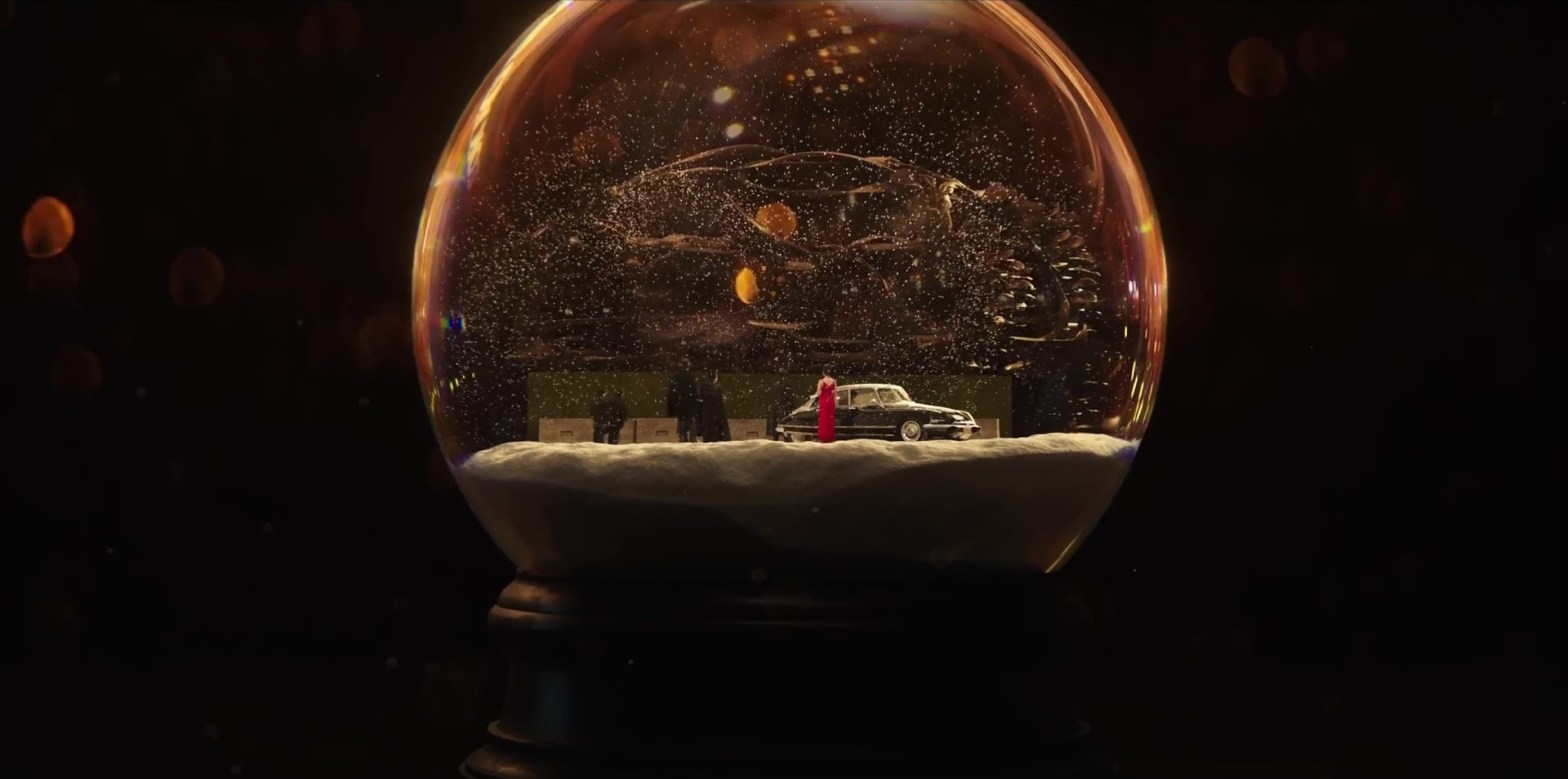
There’s a grossly uncharitable part of me that wants to say the reception of Megalopolis among wide audiences and mainstream critics is because of a net decrease in intelligence, that we’re simply too stupid to see what cinema legend Francis Ford Coppola, in the twilight of his career, has achieved. And yet there is a much louder, more sensible voice that realizes what he’s done is so damn simple, straight and true, but is complicated by a rich visual and thematic lineage that we have collectively forgotten. It’s not that Megalopolis is a 5000-IQ picture, but that Coppola is speaking to us in a language that we all once knew, but has been brought to a near-death. Latin lives in the halls of the Catholic church, and the rich history of cinema that Coppola pulls on in his futurist Catilinarian conspiracy is one largely forgotten by us as an audience, and dare I say the critics who ought to have recalled it.
Megalopolis is the story of a lone visionary architect standing in the way of corrupt politicians and jealous relatives. While many call on allusions to Ayn Rand and her forthright novel The Fountainhead, the true roots of Megalopolis go right to the heart of what Ray Bradbury once identified in the heart of Moby Dick; Shakespeare. People have described Coppola’s work here as that of a theater kid, and that it is, but one so well-versed in theater, he knows one of the oldest rules in the book: no one does it better than the Bard. Coppola uses him as the mold and casts all accordingly. From Adam Driver’s peculiar Cesar overtly quoting Hamlet to a classically mad performance from Shia LaBeouf’s Clodio to a deliciously conniving Aubrey Plaza as show-stealing Wow Platinum, every last ounce of this film reeks of Shakespeare. The conspiracies, the star-crossed lovers, the haunting tragedies & bloodshed, it is all there.
And yet, there is so much more.
From kaleidoscopic montage to the illusionary imagery of Méliès, Megalopolis pulls on silent-era expressionism, with Mihai Mălaimare Jr.’s cinematography immersing you consistently in the film’s high style. It wears the New Rome affectation exceedingly well, with Osvaldo Golijov’s music recalling the great Roman scores of Miklós Rózsa (Ben-Hur, Quo Vadis) and the production and costume design striking a perfect balance of explicit allusion and tasteful subtlety, from the overt inclusion of bread and circuses in a Colosseum-like set, to the quiet inclusion of gladiator sandals in many of the women’s ensembles. And while many identify the dialogue as very “written,” Coppola works to guide his performers through it, bringing out some stirring turns in actors like Driver. He strikes a balance of composure and volcanic emotion that wouldn’t feel out of place in late 50s/early 60s American drama, a time when Hollywood glamor was giving way to emotional fence-swinging of New York theater. Some actors struggle with that balance (Nathalie Emmanuel’s Julia never quite settles in), some are built for it (Giancarlo Esposito’s Cicero and Laurence Fishburne’s Romaine are impeccable), and some contrast it to great effect (Jon Voight is fantastic as Hamilton Crassus III and gets one of the great scenes of the film’s final act).
I won’t fit Francis for a halo just yet, because the fact that he’s gone ahead and put ALL of these techniques together, in the same film, often within the same sequences (the head-pounding delirium of Adam Driver’s bender and downfall midway through the film) makes it all incredibly hard to follow. Anyone expecting a clear linear narrative will be grossly disappointed. There is a throughline, one you can catch glimpses of if you keep that Shakespearean framework in the back of your mind, but you still have to grasp for it. That said, if one allows the film to guide their intuition, they can navigate these poetic flourishes and wild montages with more ease than most let on. I’ve always been an advocate of allowing a film the luxury to accomplish what it sets out to achieve, not what the audience wishes, and never before has a film borne that out more than Megalopolis. It doesn’t always stick its landings, Fishburne’s frame narration feels a bit on the nose at times, but it always manages to right itself in time, and to not get in the way of its own, unique lyrical flow.
The dream of a better tomorrow, of what could be in this modern fable, is the powerful, unifying factor. While people will point to allusions made to contemporary politics, I have a suspicion those are more in incident than intention. With an active history spanning 40 years of development, I’m pretty sure whenever the film got made would have naturally reflected the times in which it was made, for the New Rome of Megalopolis could easily have been brought to the Reaganite 80s, the Clintonian 90s, and so on. The key is in that back and forth of the present and the future, both shaped and guided by the past in unique ways. It is all there if you’re open and if you speak in the tongue that Coppola does.
The problem is that most don’t.
This isn’t even a value judgement, because it’s too easy to say “the audiences are too stupid” or “the doubters want it to fail.” The simple fact is that, had this been released in the 80s, when audiences and critics understood an Actors Studio performance when they saw one (or knew enough died-in-the-wool players in that style) or were truly reading Shakespeare, I guarantee that there would be a much greater connection. Megalopolis is a victim of the times in which we live. It’s the victim of an era where people are fighting each other into oblivion, an era where most media has been deemed “content” by the addiction dispensary we call the internet, an era where classics are being taught less and less, where curiosity is supplanted with complacent pleasure. An era in which the past is memory-holed, to which allusion hold barely any meaning to anyone, for you can barely recall anything to anyone.
Megalopolis speaks Latin while we’re all struggling with our own English. I’ve seen films of its kind before. It’s why Dario Argento’s Suspiria is regarded as art, but not high art. It actually helped me understand what it means to be a fable, which in turn gave me a new perspective on Walter Hill’s own brand of urban fable, like The Warriors and Streets of Fire. But like all languages, it can be taught again. And with films like Megalopolis, I hope people will realize the necessity to learn the language again.
Latin might be an odd metaphor for the film’s synthesis of ancient drama, 20th century creativity and 21st century innovations, but its the only language I feel fits, for it was once the word of the land, and it was a beautiful word, a powerful word, a robust word. And it is in understanding that word (the word of the past) that we can better recognize our place in the present, and plan for what can hopefully be a better future. For a Megalopolis yet to be.
It’s not a perfect film, it’s not a flawless film, but it is a film of rare power, a celebration of the medium it exists within, from one of the men who made such an important one. To that end, it’s tremendous. There’s a reason this man is a living legend, and I thank you for reminding us why, Francis. I sincerely thank you. If this is to be your last film (though I hope you have many more left in you), you picked a strong finish. See it in theaters while you still can.
 A Fistful of Film
One thought on “Megalopolis (2024) – A Future in Latin”